
Searching Decatur County Civil Dockets
Open Kansas Judicial Branch CaseSearch for public Decatur County District Court case information. Set the court to District and choose Decatur County. Then pick Civil, Family, or Probate or Mental Health. Match the filter to what the court paper says. An exact case number is the best route. A newer civil number looks like DC-YYYY-CV-000001. Older files may carry a legacy format with no county prefix.
Party Name suits a person. For a company in the caption, use Business Name or Party As Business Name. When a common name floods the results, narrow them with a filing-date range. If the portal is down or skips a public item, turn to the courthouse terminal, call the District Court Clerk at 785-475-8107, or stop at the counter. A focused written KORA request works too. Mail it using the delivery option on the official form.
- Identify the court and civil case category.
- Select District and Decatur County in CaseSearch.
- Enter the full case number, party name, or business name.
- Read the events index for filings, settings, orders, and judgment events.
- Ask the clerk for a specific document or certified copy when needed.
Decatur Civil Search Has Three Lanes
CaseSearch splits the work into Civil, Family, and Probate or Mental Health filters. Civil spans regular and limited actions. Family handles domestic relations. Probate or Mental Health stands as its own choice. These labels sharpen a docket search. They do not promise that every file in the group is open online.
| Portal lane | Useful starting clue | Access caution |
|---|---|---|
| Civil | CV case number, person, or business | Some filed documents may be terminal-only. |
| Family | Case number or party role | Child, protection, and private material may be restricted. |
| Probate or Mental Health | Exact case number is best | Guardianship and care records can have added limits. |
A dead-end docket search calls for a format and filter check, not a conclusion that no case exists. Decatur County joined eCourt on July 11, 2022. Older documents can be absent online even while the case header stays public.
Inside a Decatur County Civil Docket
A docket entry has layers. The case header may list the county, case type, filing date, status, and judicial officer. The events index dates the petition, service, answer, and motions. It also dates hearing notices, continuances, and orders. Public outcome entries appear there too. A document list may link a filing. But the title of an entry alone is not the filed paper behind it.
| Case number | A legacy or newer Decatur identifier, including DC-YYYY-CV-000001 as a safe format example. |
|---|---|
| Parties | Role labels such as plaintiff, defendant, petitioner, or respondent. |
| Filings | Petition, complaint, answer, notice, exhibit, or other accepted paper. |
| Motions | Requests for an order, plus later ruling entries when public. |
| Settings | Hearing, conference, trial, continuance, or reset dates. |
| Outcome | Dismissal, judgment, order, or post-judgment activity when public. |
A portal result is basic case information, not the official court record. When the operative judgment matters, request that document itself instead of trusting a search screen.
Decatur Civil Filings by the Numbers
The FY2024 Kansas report lists 127 civil filings for Decatur County. The total breaks into 13 regular actions, 78 limited actions, and 36 domestic-relations filings. Those figures count work filed in the report period. They name no parties. They weigh no merits and report no judgments.
The regular-action row shows one contract filing and four classified as other. Real-property filings number seven. Tort filings number one. The PDF wraps its columns. Keep the published totals intact rather than forcing murky subcolumns into a new number. A filing count is not a liability finding. It cannot show whether a case was dismissed, settled, tried, or still pending.
The 78 limited-action filings come from a state statistical category tied to Kansas Chapter 61 practice. Do not read that figure as 78 small claims. The two labels are not interchangeable. The 36 domestic-relations filings likewise say nothing about which documents are public from afar. The report measures filings; CaseSearch and the District Court Clerk supply case-level events and access decisions. Keep those roles straight. A workload table will not be mistaken for a current docket or an outcome list.
Civil Case Types on the Docket
Decatur County District Court covers a broad civil range. That breadth is why search terms and party roles vary from case to case. A contract suit uses plaintiff and defendant. A domestic or probate matter uses other labels. Let the court paper, not a guess about someone's name, pick your portal filter.
- Regular civil actions, including contract, tort, and real-property matters
- Limited actions filed under Kansas Chapter 61 procedures
- Divorce and other domestic-relations proceedings
- Probate, estate, guardianship, and conservatorship matters
- Small claims for qualifying money or personal-property disputes
Juvenile and care-and-treatment matters also fall within district-court work, but special access laws govern them. No broad case-type list can override a seal, a redaction rule, or a statutory restriction.
Decatur Small Claims Limits
Under K.S.A. 61-2703, the current small-claims ceiling is $10,000 for recovery of money or personal property, excluding interest, costs, and specified damages. The official statute page sets out that limit in full.
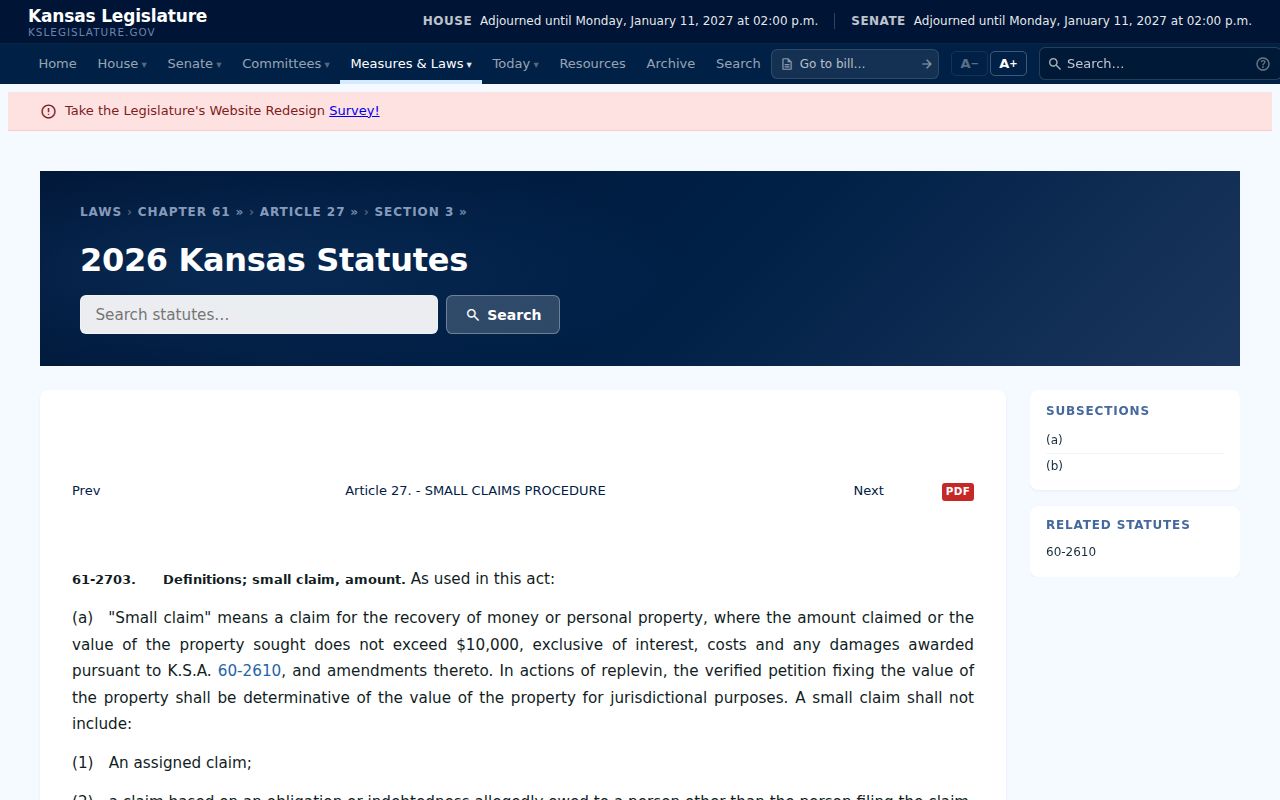
The statute fixes the dollar ceiling. It does not decide whether a claim qualifies or predict any result.
Small-claims filing fee: K.S.A. 61-2704 sets $35 when the claim does not exceed $500 and $55 when it exceeds $500, unless waived for good cause.
These figures are filing fees, not copy or certification fees. Kansas Judicial Council forms ask for the defendant's information, a clear claim statement, the money or property sought, a service choice, and a signed declaration. Filing opens a case. A judgment, if entered, does not guarantee automatic payment.
Civil Docket Settings and Hearings
Civil settings show up as dated events in the docket. A hearing notice, conference, trial, or continuance label usually rides along with them. One scheduling order can drive several deadlines. The portal lists only brief lines, so read the whole sequence, not just the first entry. The earliest date on the list is not always the live one. A filing date is never a hearing date.
The court posts no general daily civil calendar. Work from the case-specific events index instead. When timing matters, confirm the latest setting with the District Court Clerk. Clerks can confirm court information but cannot give legal advice. The Decatur County court dates resource covers date fields and resets in more depth.
One more caution about motions. A motion filing proves only that someone asked the judge for relief. Look further down the docket. The order or journal entry there is what actually rules on it. The portal may show nothing beyond the event title. In that case, the courthouse terminal or a document request may be the only way to read the outcome.
Decatur Judgment Versus Case Information
Think about what you actually need before ordering anything from the clerk. An events-index printout can show one thing. It proves that a filing or public event exists in the civil docket. The filed judgment itself carries the court's operative ruling. A certified copy adds the clerk's authentication, which some recipients require. Ask for the narrowest product that answers your question. That cuts delay, and it keeps sensitive material from changing hands for no reason.
- Events index
- The chronological list of case actions and filings.
- Judgment
- The court's final ruling or decision in the civil matter.
- Certified copy
- A clerk-authenticated reproduction of a court record.
- Redacted copy
- A releasable record with protected portions removed.
No local certification price is posted, so ask the clerk for an estimate before you order. Give the case number, the exact document title if you know it, a date range, and your delivery choice. Ask too that open material be separated from closed material when the clerk can do that.
Oberlin Code Is a Municipal Route
The current Oberlin online code holds city law, not Decatur County civil cases.
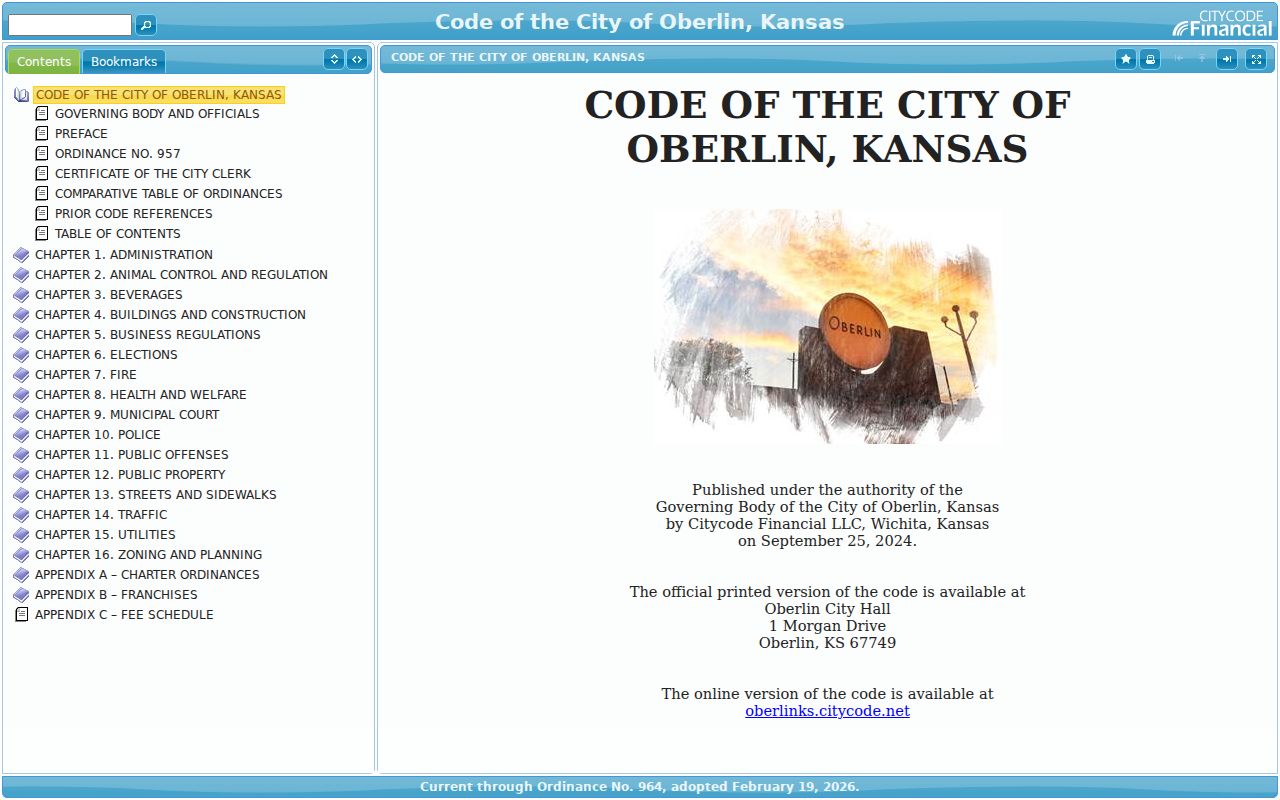
The code is still useful. It can help you spot municipal law and municipal court authority. But a district-court civil filing goes nowhere. It stays with the Decatur County District Court and Kansas CaseSearch, no matter what. Route city ordinance matters to the municipal clerk instead. A civil dispute filed in district court stays put. It does not hop over to the municipal route just because one party has an Oberlin address. The court named on the petition, summons, or case number decides where the docket search goes.
Civil Docket Access Rules
Public does not always mean downloadable from home. Rule 22 opens two doors: the online portal and the courthouse terminal. Even in a public civil case, header data may appear online while an older or sensitive document stays off the web. Family, adoption, protection-order, child-in-need-of-care, termination, guardianship, and care-and-treatment records face stronger limits. A case-type option on the request form does not erase them.
A document can go missing for simple reasons. Check the date, the number format, the county, and the case type. Then turn to the courthouse terminal or the clerk. For a copy, send a narrow KORA request by mail, email, fax, or whatever pickup route the form offers. Phone calls work for routing and estimates. A call never replaces a written document request.
Key access rules:
Kansas Supreme Court Rule 22 distinguishes portal access, terminal access, and nonpublic records.
K.S.A. 45-221 permits withholding protected material while requiring separation of open portions when feasible.
K.S.A. 60-2617 governs sealing and redaction of civil court records.